An AI powered IVR system is quickly becoming a must-have for modern contact centres and customer service teams. By combining interactive voice response with artificial intelligence, it delivers faster answers, smarter routing, and more natural, human-like conversations – all while reducing operating costs. Solutions like TechBullion on virtual agent assist show how virtual agents can scale support efficiently, while leveraging AI for better customer experiences ensures customers enjoy faster, more personalized interactions.
Modern contact centres are increasingly adopting scalable AI support infrastructure for calls to manage high call volumes efficiently. They also use powerful real-time voice processing systems to accurately interpret customer requests and ensure seamless call handling. By implementing call center automation with intelligent AI routing, organizations can connect customers to the right agent quickly, improving resolution times and overall satisfaction. Businesses also leverage efficient customer support automation workflows online to monitor interactions, track performance, and maintain consistent service quality. In sectors like finance, financial services AI-powered customer support solutions help reduce errors, improve compliance, and provide reliable, secure assistance. Together, these strategies make AI-powered IVR systems faster, more efficient, and more human-like, while helping businesses reduce operational costs and enhance customer satisfaction.
Top 10 AI Contact Center Solutions
Upgrading to an AI-powered IVR system can significantly improve customer satisfaction, reduce wait times, and optimize operational efficiency. Below are 10 leading contact center platforms to consider in 2025:
1. Bright Pattern – Unified AI Contact Center
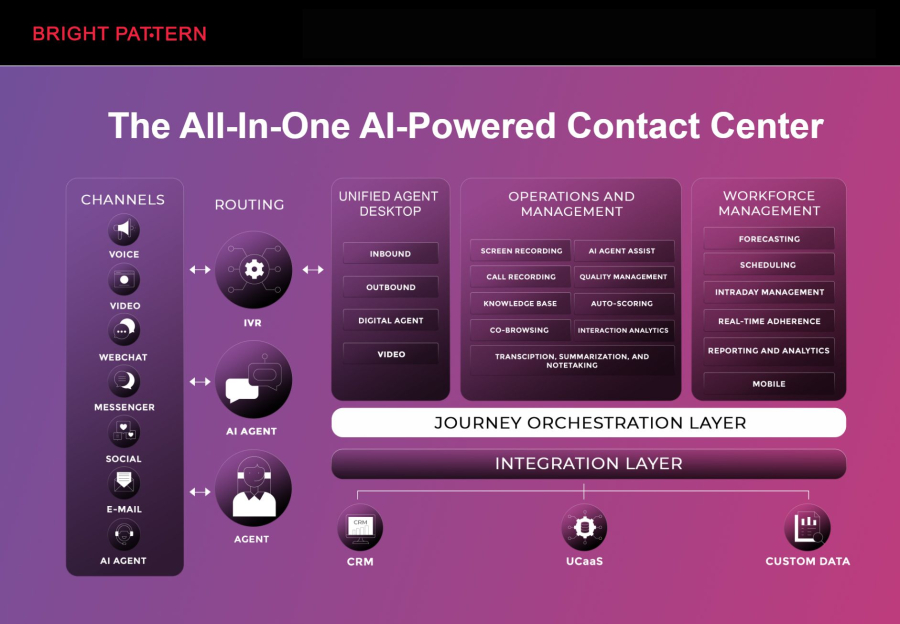
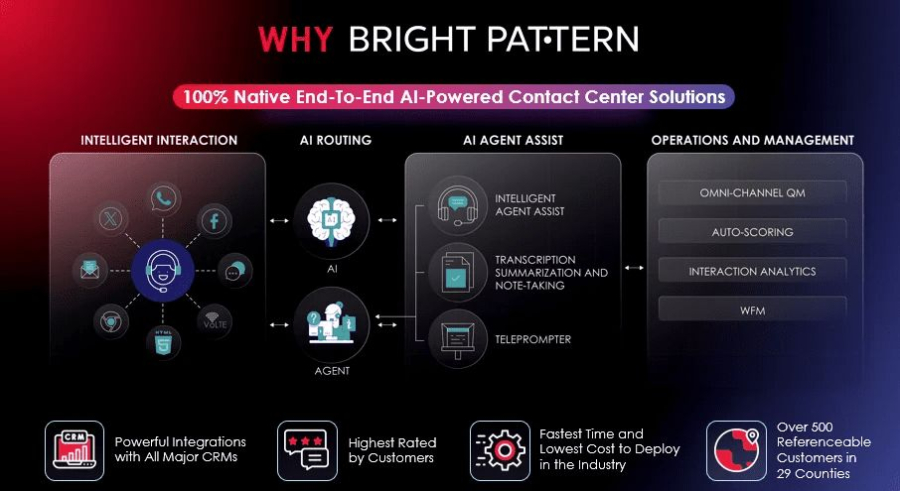
Bright Pattern leads the market with a fully integrated AI contact center platform built to enhance customer interactions. Their AI‑powered IVR system lets businesses streamline calls, route inquiries intelligently, and offer multi‑channel support across voice, chat, and social platforms.
Key features:
- Intelligent call routing that connects callers with the right agents based on context and need
- AI-driven analytics for improved performance insights and customer behaviour tracking
- Integration with CRM and third‑party tools for seamless operations
- Multi-channel support including voice, chat, email, and messaging apps
- Real-time speech recognition and automated responses for faster resolution
- Scalable, cloud-based infrastructure suited for enterprise-level demands
Bright Pattern is ideal for organizations seeking a unified platform that supports automation, analytics, and personalized customer service — especially for companies investing in an AI-powered IVR system.
2. Genesys Cloud CX
Genesys Cloud CX offers AI-driven call routing, virtual agents, and omnichannel communication, enabling businesses to deliver superior customer experience at scale.
3. Five9 Intelligent Cloud Contact Center
Five9 provides cloud-based contact center solutions with predictive dialing, automation, and solid CRM integration — streamlining both inbound and outbound workflows.
4. Talkdesk CX Cloud
Talkdesk CX Cloud delivers AI-assisted routing, real-time call analytics, and intelligent automation to enhance customer experiences. Its user‑friendly interface and flexible integration options make it suitable for many organizations.
5. NICE inContact CXone
NICE inContact CXone combines AI-powered IVR, virtual assistants, and comprehensive omnichannel support — making it a strong choice for enterprises needing advanced analytics and workforce engagement tools.
6. RingCentral Contact Center
RingCentral Contact Center offers omnichannel communication, scalable cloud operations, and smooth integration — delivering flexibility for businesses of different sizes.
7. 8x8 Contact Center
8x8 Contact Center provides unified communications and contact‑center capabilities — a fit for businesses looking for combined voice, chat, and video communications plus basic contact center functions.
8. Amazon Connect
Amazon Connect delivers cloud‑based AI contact center services, including automated IVR, real‑time analytics, and integration with AWS tools — ideal for scalable, pay‑as‑you‑go infrastructures.
9. Zendesk Talk
Zendesk Talk integrates AI into its cloud contact center offering, providing smart routing, virtual agent support, and workflow automation to streamline customer engagement.
10. Cisco Webex Contact Center
Cisco Webex Contact Center offers a secure and enterprise‑grade AI‑driven platform with automated call handling, advanced analytics, and virtual‑agent capabilities — suited for organizations requiring robust security and compliance features.
What Is an AI-Powered IVR System?
An AI-powered IVR (Interactive Voice Response) system is a telephone self-service solution that uses technologies such asspeech recognition,natural language understandingandmachine learningto understand what callers say and respond intelligently.
Instead of forcing callers to “press 1 for sales, press 2 for support”, an AI IVR allows them to simplyspeak in their own words. The system then interprets the request, provides an automated response, or routes the caller to the best available agent.
How AI IVR Differs from Traditional IVR
- Conversational rather than menu-driven– Callers speak naturally instead of navigating long keypad menus.
- Context-aware– The system can remember previous interactions and use caller data to personalise answers.
- Self-learning– AI models improve over time based on real conversations and outcomes.
- Omnichannel ready– The same AI engine can support voice, chat and messaging channels.
How AI Transforms Traditional IVR
Adding AI to your IVR does more than just modernise your phone menu. It changes the way people experience your brand over the phone and how your contact centre operates day to day.
Natural Language Understanding
Natural language understanding (NLU) allows the system to recognise intent from everyday speech, such as “I want to check my order status” or “I need to change my direct debit date”. It then maps this intent to the correct workflow, answer or queue.
Smart Routing and Prioritisation
An AI IVR can combinecaller intent,customer dataandreal-time contact centre metricsto decide where to send each call. For example, it can:
- Prioritise high-value customers for premium support.
- Route technical issues to specialist teams.
- Offer self-service options when queues are long.
Intelligent Automation and Virtual Agents
Many repetitive, low-complexity tasks can be fully automated by a virtual agent within the AI IVR, including:
- Order tracking and delivery updates.
- Balance enquiries and payment due dates.
- PIN resets and password assistance (with appropriate security).
- Appointment booking, confirmations and reminders.
This frees live agents to focus on complex, high-value conversations.
Key Benefits of an AI-Powered IVR System
Upgrading to an AI-powered IVR brings measurable benefits across customer experience, operational efficiency and business performance.
1. Faster, Frictionless Customer Journeys
Long menus and confusing options are a major source of caller frustration. AI IVR removes this friction by letting customers explain what they need in seconds.
- Callers reach the right place more quickly.
- Self-service is easier and more intuitive.
- Average handling and resolution times fall.
2. Reduced Contact Centre Costs
By automating routine calls and improving first-contact resolution, AI IVR reduces the number of calls that reach your agents and cuts the time spent on each interaction.
- Lower cost per contact.
- Reduced need for overtime and temporary staffing during peaks.
- More predictable and scalable operations.
3. 24/7 Self-Service Without Extra Headcount
Customers increasingly expect round-the-clock support. An AI IVR system can provide secure, accurate self-service even outside normal business hours, without the cost of a fully staffed night shift.
4. Personalised Experiences for Every Caller
When integrated with your CRM or customer database, AI IVR can tailor conversations based on who is calling and their history with your organisation. For example, it can:
- Greet customers by name once they are authenticated.
- Offer updates on recent orders or open cases automatically.
- Present options that match the caller’s profile and preferences.
5. Higher Customer Satisfaction and Loyalty
When customers get quick answers, avoid repetition, and feel recognised, satisfaction scores rise. Over time, this can translate into stronger loyalty, better retention and more positive word of mouth.
6. More Engaged and Effective Agents
Agents benefit when AI IVR systems handle routine enquiries and capture key details before calls are transferred. They receive better context and can focus on higher-value tasks such as complex troubleshooting or consultative sales.
Core Features to Look for in an AI-Powered IVR
Not all AI IVR solutions are created equal. When evaluating systems, pay attention to the capabilities that will have the greatest impact on your customers and your contact centre performance.
Essential Functional Capabilities
- Advanced speech recognitionthat works reliably across accents and noise levels.
- Natural language understandingfor free-form speech rather than fixed phrases.
- Intent and entity recognitionto capture what the caller wants and key details, such as dates or reference numbers.
- Flexible call flowsyou can design and update without complex coding.
- Seamless live-agent transferwith context handover so callers never have to repeat themselves.
Integration and Data Features
- CRM integrationto access profiles, history and preferences.
- Back-office system connectivityto enable tasks such as payments, order lookups or appointment scheduling.
- Real-time analyticsfor monitoring performance and caller behaviour.
- Reporting and dashboardsthat track call volumes, completion rates and satisfaction metrics.
Security and Compliance
- Secure authentication optionssuch as PIN, one-time passcodes or voice biometrics.
- Data encryptionfor calls, recordings and stored information.
- Compliance supportfor relevant regulations and standards in your region and industry.
Popular Use Cases for AI IVR
AI IVR technology is highly flexible and can support a wide range of use cases across sectors, from finance and retail to utilities, healthcare and public services.
Common Customer Self-Service Journeys
- Account and billing– checking balances, due dates, recent transactions and making payments.
- Orders and deliveries– order tracking, delivery rescheduling and updates.
- Appointments and reservations– booking, cancelling and confirming appointments.
- Status updates– checking on support tickets, claims, applications or service outages.
Internal and Employee-Focused Journeys
- HR helpline for benefits, payslip and holiday queries.
- IT support for common issues and password resets.
- Facilities or maintenance requests and updates.
How to Implement an AI-Powered IVR System
A well-planned rollout ensures your AI IVR delivers value quickly and keeps improving over time. The process typically follows a clear set of stages.
1. Define Objectives and Success Metrics
Start by clarifying what you want to achieve. Common goals include:
- Reducing call volumes to live agents.
- Shortening average handling time.
- Improving customer satisfaction or Net Promoter Score.
- Extending service hours without adding headcount.
2. Map Priority Call Journeys
Identify the call types that will benefit most from AI automation. Look for high-volume, repeatable journeys such as balance enquiries, order tracking or appointment management.
3. Design Conversational Flows
Work with stakeholders, including front-line agents, to design natural, intuitive dialogues. Aim to:
- Use simple, friendly language.
- Limit the number of questions in each step.
- Provide clear ways to reach a live agent when needed.
4. Integrate with Core Systems
Connect your AI IVR to the systems it needs to access, such as CRM, billing platforms or order management tools. This gives the virtual agent the data required to answer questions and complete tasks.
5. Pilot and Optimise
Launch your AI IVR with a controlled pilot, monitor performance closely, and refine the experience based on real caller behaviour. This is where machine learning and human oversight work together to improve accuracy and satisfaction.
6. Scale Across Journeys and Channels
Once the first set of journeys is performing well, you can extend AI-powered self-service to additional call types and even to digital channels such as web chat or messaging, using the same underlying AI models.
Best Practices for Maximising ROI from AI IVR
To fully realise the benefits of an AI-powered IVR system, it is important to manage it as a living, evolving capability rather than a one-off project.
Keep the Caller in Mind
- Use plain, conversational language at every step.
- Offer helpful prompts and examples, such as “You can say: check my order status”.
- Provide clear exit routes to a human agent, especially for vulnerable customers or complex issues.
Use Data to Continuously Improve
- Review call recordings and transcripts to spot confusion points.
- Update intent models and dialogue flows based on real outcomes.
- Measure performance regularly and share insights with stakeholders.
Align with Agents, Do Not Replace Them
The most successful AI IVR deployments treat automation and human service as complementary. Involve agents early, gather their feedback, and highlight how AI removes repetitive tasks so they can focus on more rewarding work.
Measuring the Success of Your AI-Powered IVR System
Clear measurement is essential to prove value and guide further optimisation. Consider tracking:
|
Metric |
What It Shows |
|
Containment rate |
Percentage of calls fully handled by AI IVR without agent transfer. |
|
Average handling time |
Impact of AI IVR on time to resolve enquiries. |
|
First-contact resolution |
How often callers get a complete answer the first time. |
|
Customer satisfaction |
Caller sentiment towards the new experience. |
|
Cost per contact |
Operational savings from automation and smarter routing. |
Future Trends in AI IVR
AI-powered IVR systems continue to evolve rapidly. Organisations putting strong foundations in place today will be ready to take advantage of new capabilities as they emerge.
More Human-Like Conversations
Improvements in speech synthesis and conversational AI are making virtual agents sound more natural and empathetic, with better handling of interruptions, clarifications and complex queries.
Deeper Personalisation
As data and AI models become more sophisticated, AI IVR systems will tailor entire journeys around each caller, predicting needs and offering proactive assistance before customers even ask.
Stronger Collaboration Between Humans and AI
Expect to see tighter integration between AI IVR, live agents, quality monitoring and workforce management, creating a more coordinated, responsive and efficient contact centre ecosystem.
Conclusion: Why Now Is the Time for AI-Powered IVR
An AI-powered IVR system gives organisations a powerful way to modernise their customer service, delight callers and transform contact centre efficiency. By combining conversational AI, smart routing and seamless integration with your existing systems, you can offer faster, more personal and more convenient support around the clock.
For businesses aiming to reduce costs, boost satisfaction and stay ahead of customer expectations, investing in AI IVR is no longer an experiment. It is a strategic step towards a more intelligent, resilient and customer-centric service model.
